
Every growing organization develops repeatable knowledge: how to onboard a new employee, use a system, follow a process, explain a product, comply with a procedure or serve a customer.
The problem is that knowledge often remains in one person’s head—or in a long document nobody reads.
Video can make procedures easier to understand, but conventional production creates another problem: when the process changes, the video becomes outdated.
AI-assisted training video platforms can reduce that maintenance burden.
Synthesia is especially relevant to this use case. Its current official materials position the platform for presenter-led training, onboarding, sales enablement, internal communication and marketing, with AI avatars, voiceovers, translation and easy script-level updates.
The business case for AI training video
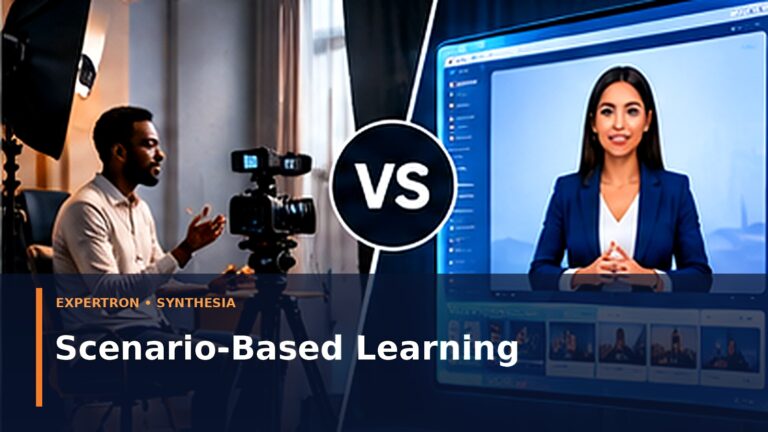
Traditional video:
plan → schedule presenter → film → edit → approve → publish.
Update one important paragraph six months later? Potentially repeat several stages.
AI-assisted presenter video:
script → choose/create presenter → generate → review → publish.
Update: edit the script, regenerate the affected content, review.
The value is not that AI makes training automatically good. The value is that it can reduce the cost of keeping good training current.
Where it works well
New-employee onboarding
Welcome, systems overview, process orientation and role-specific basics.
Standard operating procedures
Show the sequence for repeatable processes.
Software/product explanation
Combine screen demonstrations with presenter-led context.
Sales enablement
Keep product positioning and internal sales guidance consistent.
Customer education
Explain setup, usage and frequently asked questions.
Multilingual workforces
Synthesia currently promotes video/voice translation across 160+ languages and a large avatar/voice selection. This can make one approved source script easier to localize.
The right workflow
1. start with the learning outcome
“At the end, the employee can correctly qualify and record a new lead.”
That is better than “Make a CRM training video.”
2. have the subject expert write or approve the source
AI can organize the script, but process owners must confirm what is true.
3. break training into short modules
One giant 75-minute AI presentation is not automatically better than a manual.
Use modules around specific tasks.
4. show the process
For software, combine explanation with authentic screen capture where appropriate. For physical tasks, use real demonstrations when safety or technique matters.
5. add knowledge checks outside the video
Watching is not proof of learning. Use quizzes, supervised practice or workflow checks where necessary.
6. localize from an approved master
Finalize the source-language version before translating. Then have competent reviewers check important localized versions.
7. create an update owner
Every training asset needs someone responsible for checking whether it remains current.
AI reduces update friction but does not know when company policy changes unless your system tells it.
When a real human presenter is better
Leadership messages where personal presence matters.
Sensitive cultural change.
High-emotion communication.
Demonstrations requiring real physical technique.
Safety-critical instruction where exact human demonstration is necessary.
Situations where employees need to build a relationship with the actual leader.
Hybrid is often best.
Consent and AI avatars
Use platform-provided avatars according to terms, or create personal avatars only with appropriate consent. Do not impersonate employees, executives or customers.
If a digital presenter could reasonably be mistaken for a specific real person, clarity and authorization matter.
Measure training outcomes
Completion rate.
Assessment performance.
Time to competency.
Reduction in repeated support questions.
Error rate.
Update time/cost.
Employee feedback.
“Number of videos generated” is not a training outcome.
A small-business example
A 15-person service business hires new customer-service staff.
Instead of the owner repeating the same two-hour orientation:
Module 1: company/customer promise.
Module 2: enquiry capture.
Module 3: follow-up process.
Module 4: escalation.
Module 5: CRM demonstration.
The owner records a personal welcome. Repeatable process modules use AI-assisted video. Live coaching handles judgment and exceptions.
That is automation supporting people, not replacing management.
Frequently asked questions
Can Synthesia create training videos without filming?
Yes, its current platform supports presenter-led AI video creation using avatars and generated voice.
Can the same training be translated?
Current Synthesia materials advertise translation/voice capabilities across 160+ languages. Important translations should still be reviewed.
Will AI training replace trainers?
Not generally. It is better viewed as a scalable delivery layer for repeatable knowledge. Coaching, assessment and judgment remain human responsibilities.
How often should training videos be reviewed?
Tie reviews to process changes and set a regular review cycle for important material.
Final thought
The best AI training system makes organizational knowledge easier to teach, update and find—while keeping accountable humans responsible for what employees learn.
AI Made Simple: AI Made Simple.
Business automation assessment: Business Growth & Automation Assessment.